- The Kona Region and its Ideal Climate - Grown on the mountain slopes of Hualalai and Mauna Loa volcanoes - Tropical sun-drenched mornings and misty afternoons
- The Care We Take with this Rare Commodity - Hand-picked - the Pride of Work of less than 600 Farms.
- Our Special Processing - Wet-method processing and sun-drying insure a Certified gourmet product
-
Our History and Culture
- From the early Polynesian settlers to the unique blend of peoples that have fashioned Kona's renaissance farmers -
The Terminology
- How we describe Kona Coffee from Cherry to Roast
100% KONA COFFEE - WHAT MAKES IT SO UNIQUE?
 Naturally High Quality and Extra Care Results in a Gourmet Coffee
- Most Kona coffee is graded Prime or better because of the climate, the careful hand-cultivation, and the wet-method processing used throughout the region.
Naturally High Quality and Extra Care Results in a Gourmet Coffee
- Most Kona coffee is graded Prime or better because of the climate, the careful hand-cultivation, and the wet-method processing used throughout the region.
Like fine vintage wines, 100% Kona coffee is distinguished from commercial blends by the tremendous extra care taken throughout every step of the process. The end result is a coffee that carries the unique stamp of the Kona region - delicate yet flavorful and with a rich aroma - a product that is famous among coffee drinking societies throughout the world. This excellent quality has made Kona coffee one of the most highly valued coffees in the world.
Grown only in Kona
Kona is the very special coffee
grown on the dark volcanic lava rock slopes of Kona, with enviable consistent
quality. Kona coffee is a deliciously rich, medium-bodied and slightly
acidic coffee with a heady aroma and complex, winey, spicy taste.
Kona, (map) on the west coast
of Hawaii island (also known as The Big Island), has produced coffee continuously
since the early 1800's. The Kona name only applies to beans grown
in North and South Kona, and coffee that is grown elsewhere in Hawaii cannot
be called Kona coffee.
The Perfect Climate
Coffee requires a very specific combination of sun, soil, and water.
It is successfully grown in only a limited number of locations round the
world. The magical diurnal cycle of bright sunny mornings, humid rainy
afternoons, and mild nights create perfect growing conditions for exotic
plants to flourish. The trees thrive on the volcanic rocky land, and mild
frost-free temperatures.
Small Independent Farms
The Kona region contains approximately 600 independent coffee farms. Most are small, usually three to seven acres in size. Traditionally, as with most farms, they are a family concern. In 1997 the total Kona coffee acreage was 2290 acres and green coffee production just over two million pounds.
Hand-Picked, Meticulously Cultivated
Coffee cultivation is more labor intensive in Kona than in most other
regions.
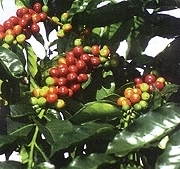 From
late August to late January, the Kona coffee farmer is singularly focused
on bringing in the ripe red coffee cherry, processing the cherry into coffee
beans, and preparing for the sale or storage of their coffee. Hand-picking
is a meticulous process than insures that only cherries at peak maturity
are harvested. Since the cherries do not ripen at the same time, each tree
will be picked several times throughout the season.
From
late August to late January, the Kona coffee farmer is singularly focused
on bringing in the ripe red coffee cherry, processing the cherry into coffee
beans, and preparing for the sale or storage of their coffee. Hand-picking
is a meticulous process than insures that only cherries at peak maturity
are harvested. Since the cherries do not ripen at the same time, each tree
will be picked several times throughout the season.
Pride of Production
Many Kona coffee farmers sell the fresh coffee cherry to Kona processors,
but there is a recent trend to take an individual farm's coffee further
along the process, selling at the parchment level, the green, and the roasted
levels. There are more than 100 private labels for Kona coffee.
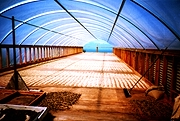
Wet-Method Processed - Sun-Dried
Coffee cherry is pulped to remove the
outer flesh, carefully fermented, which helps give the coffee its characteristic
bright, clear flavor, and thoroughly washed in clean water. Most coffee
is then naturally sun-dried on large decks (hoshidanas), and raked regularly
to give even drying.
Graded to Department of Agriculture
Standards
The dry beans are machine milled to remove the parchment and silverskin,
and the resulting green beans sorted and graded. The green beans may be
sold to roasters, or custom-roasted by the farmer or processor to produce
a unique coffee.
The Kona History
The first settlers in Hawaii arrived
in approximately 300-400 AD, probably from the Marquesas Islands. They
brought with them taro, ti, sugarcane, ginger, gourd, yams, bamboo, turmeric,
arrowroot, and the breadfruit tree. They also brought small pigs, dogs,
jungle fowl, and probably rats as stowaways. Many of these new species
overpowered the native plants and animals, especially birds. They established
a rigid and controlled society, rich in oral and music traditions, although
lacking in written language. Hereditary chiefs held blocks of land, and
their people paid taxes to their chief (crops or catch) and served for
them as soldiers. Strict laws defined what was forbidden and governed the
conduct of the various levels of society. There were many wars between
the chiefs. Religion consisted of the worship of many gods and goddesses,
representing war, life, death, harvest, etc.
The Europeans arrived by accident while searching for the fabled Northwest Passage, a hoped-for new spice route to the Orient. James Cook, an English Sea Captain, reached Kauai
in January 1778, replenished his ship, and returned in early 1779 after being forced back by winter storms, to anchor in Kealakekua Bay,
Kona. Hawaii became an important stopping
place on one of the world's major trading routes. The Hawaiian chiefs traded
sandalwood for foreign weapons and goods, including cattle, goats, and
pigs which rapidly over-ran the island destroying the ground cover.
The Missionary Era started around 1820 and their religious beliefs
quickly overcame the old system of kapu. Many of the churches they
established still exist today.
Coffee Plantations - Coffee was first brought to Kona by Samuel
Reverend Ruggles from cuttings from Brazil, although it was not until much
later in that century that it became a consistent and worthwhile crop.
It was grown on large plantations, but the crash in the world coffee market
in 1899 caused plantation owners to have to lease out their land to their
workers. Most of these workers were originally from Japan, and they worked
their leased land parcels of between 5 and 12 acres as family concerns,
producing large, quality coffee crops.
Family Farms The tradition of running family farms has continued
throughout Kona. The Japanese-origin families have been joined by Filipinos,
mainland Americans, and Europeans - all of who strive to keep their farms
productive, their crops as perfect as can be, and their family lifestyle
serene. This family orientation has produced a close sense of community,
with care and compassion to spare, and a friendly welcome for all who come
to visit.
| Kona Coffee from Cherry to Roast | |
| Kona Snow | White sweet-smelling blossoms that cover the trees at intervals from January through May. |
| Cherry | The fruit of the coffee tree, starts as green berries, turning through yellow to orange and picked when deep red. |
| Bean | The two flat seeds formed within the normal cherry - Type I. . |
| Peaberry | When coffee cherries produce only one round seed instead - Type II of two flat ones |
| Pulping | Separating the beans from the outer red skin |
| Processing (wet-method) | The beans are fermented from 12-24 hours,and then washed in fresh water. |
| Drying | The washed beans are laid out on decks and sun-dried to a moisture level between 10-13%. Some mechanical drying may be used, but most Kona beans are sun-dried. |
| Parchment | The dried seeds covered with a stiff white skin, called parchment. |
| Milling | Removal of stiff parchment skin and the thin silverskin below it |
| Green | Coffee beans milled and ready for roasting |
| Roast | Cooking the green coffee to the desired taste. |